But thankfully, it's the life-giving kind of weight :).
I realized recently that there are some people who read this blog who aren't on Facebook ... and thus might not know that Colin and I are expecting a baby on December 1st. So here's the official announcement, with apologies for the delay!
To the right is a photo at about 28 weeks. We don't yet know if baby Mathewson is a boy or a girl (and won't know until the day of the birth, unless the doctor slips up and spills the beans, since the info is in my chart). Any guesses?
As has been pointed out to us, it appears we like to take on multiple major life transitions at once: moving, starting seminary, becoming parents. Or getting married, moving, and joining a new intentional community, to name a past example. So maybe it's true, we like to take life in big chunks. But we're grateful for this expectation of new life, even though -- as everyone says -- we really have no idea how this little person will change our life :).
Sunday, September 19, 2010
Tuesday, August 24, 2010
Sunday, August 22, 2010
Our Visit to Cordoba, Spain
In early June Laurel and I met up with my mom, dad, and sister for a 10-day visit to southern Spain. What I learned about and saw during our short time there was so surprising I needed more time to process before writing on it. Now that we're fairly settled into Tennessee I'm starting to reenter the news cycle again, and the current controversy over the siting of Cordoba House, the proposed Muslim community center and prayer space, near New York's Ground Zero reminded me that I still owed myself (and others?) some reflection on our brief time in Cordoba, Spain.
Our rental car's GPS passive agressively guided us the "direct" (wrong) way down one-way narrow streets in the city's historic center before encouraging us with a chuckle to drive over what seemed to be a small pedestrian plaza to our hotel. Huh: a broad, tree-lined street seemed to lead to our destination as well, but what fun would that have been? After unloading the luggage, we struck out on middle-of-the-day, searingly sunny march for lunch and to get what my dad refers to as a "lay of the land." We made it a few hundred yards before tucking into some tapas, some of our best yet of the trip: rabo del toro (ox-tail roasted tender) was a delicious specialty.
By a stroke of luck, that evening we watched a full-scale public procession from the Cathedral to the center square commemorating Corpus Christi, a Christian holiday celebration for which Cordoba is known. Rosemary, sage, and lavender scattered thickly along the parade route stirred up a rich citrus-y aroma as on-lookers peeked from balconies decorated with hand-painted tasseled silk scarves. Patios, also of Cordoban renown, beckoned from behind iron-grilled gates or appeared suddenly upon turning up a quiet alley -- their potted flowers reflected in the surface of cool gurgling water fountains.
The next morning we entered the Mezquita, the principal tourist attraction of this Andalusian town. Spanish for "mosque," the Mezquita symbolizes and embodies to this day the tension between and the fusion of Christianity and Islam. What a sight it is: Quiet, dark, low-ceilinged intimate space and stretch-to-infinity Moorish arches supported by delicate columns greet us as we enter. Suddenly, in the center of this peaceful labyrinth, a blindingly white, soaring-roofed, Baroque-ly loud and triumphant cathedral appears, stitched seamlessly into the mosque's arches. You got it: not a cathedral built over a mosque built over a church (a dime a dozen throughout southern Spain), but a cathedral built within a mosque built over a church. Regardless of the architectural mixed messages, since the Reconquista victory in 1236 the Catholic Church has treated the sacred space as unambiguously Christian.
In this place history's interpretation matters. After local Muslims expressed an interest recently to resume Friday prayer here, the Catholic Diocese of Cordoba responded with a glossy marketing display emphasizing that "the Cathedral of Cordoba is not simply a monument or a temple of different cultures; nor is it a mosque, but the Mother Church of the Diocesis." In other words: no.
But there is more to a history including a small Visigothic church at this site, its destruction at the hands of the Moors and the subsequent construction of the third largest mosque in the world during the Caliphate of Cordoba, and its Christian co-optation by King Ferdinand III as the Christians marched steadily south, eventually completing the "reconquest" of Spain over the Moors in Granada in 1492. In the twelfth century, while under Moorish rule, Cordoba was the largest city in Europe, the first with lighted streets and indoor plumbing, and producer of some of the finest minds of the Middle Ages, including the great Jewish and Muslim philosophers Maimonides and Averroes.
This period of Moorish religious tolerance and blossoming civilization inspired the developers of the proposed Islamic prayer space and community center to name the project "Cordoba House." While I don't profess to know the ins and outs of the current controversy over the siting of this center so close to Ground Zero, I believe strongly in the potential of the peoples of the Book (Jews, Christians and Muslims) to find much common ground in their overlapping faiths and to build great things from this shared foundation. It happened in Cordoba once. And the Mezquita's Islamic-Christian architecture may one day herald the way ahead: from pain and conquest to dialogue and reconciliation.
Our rental car's GPS passive agressively guided us the "direct" (wrong) way down one-way narrow streets in the city's historic center before encouraging us with a chuckle to drive over what seemed to be a small pedestrian plaza to our hotel. Huh: a broad, tree-lined street seemed to lead to our destination as well, but what fun would that have been? After unloading the luggage, we struck out on middle-of-the-day, searingly sunny march for lunch and to get what my dad refers to as a "lay of the land." We made it a few hundred yards before tucking into some tapas, some of our best yet of the trip: rabo del toro (ox-tail roasted tender) was a delicious specialty. By a stroke of luck, that evening we watched a full-scale public procession from the Cathedral to the center square commemorating Corpus Christi, a Christian holiday celebration for which Cordoba is known. Rosemary, sage, and lavender scattered thickly along the parade route stirred up a rich citrus-y aroma as on-lookers peeked from balconies decorated with hand-painted tasseled silk scarves. Patios, also of Cordoban renown, beckoned from behind iron-grilled gates or appeared suddenly upon turning up a quiet alley -- their potted flowers reflected in the surface of cool gurgling water fountains.
The next morning we entered the Mezquita, the principal tourist attraction of this Andalusian town. Spanish for "mosque," the Mezquita symbolizes and embodies to this day the tension between and the fusion of Christianity and Islam. What a sight it is: Quiet, dark, low-ceilinged intimate space and stretch-to-infinity Moorish arches supported by delicate columns greet us as we enter. Suddenly, in the center of this peaceful labyrinth, a blindingly white, soaring-roofed, Baroque-ly loud and triumphant cathedral appears, stitched seamlessly into the mosque's arches. You got it: not a cathedral built over a mosque built over a church (a dime a dozen throughout southern Spain), but a cathedral built within a mosque built over a church. Regardless of the architectural mixed messages, since the Reconquista victory in 1236 the Catholic Church has treated the sacred space as unambiguously Christian.
In this place history's interpretation matters. After local Muslims expressed an interest recently to resume Friday prayer here, the Catholic Diocese of Cordoba responded with a glossy marketing display emphasizing that "the Cathedral of Cordoba is not simply a monument or a temple of different cultures; nor is it a mosque, but the Mother Church of the Diocesis." In other words: no.But there is more to a history including a small Visigothic church at this site, its destruction at the hands of the Moors and the subsequent construction of the third largest mosque in the world during the Caliphate of Cordoba, and its Christian co-optation by King Ferdinand III as the Christians marched steadily south, eventually completing the "reconquest" of Spain over the Moors in Granada in 1492. In the twelfth century, while under Moorish rule, Cordoba was the largest city in Europe, the first with lighted streets and indoor plumbing, and producer of some of the finest minds of the Middle Ages, including the great Jewish and Muslim philosophers Maimonides and Averroes.
This period of Moorish religious tolerance and blossoming civilization inspired the developers of the proposed Islamic prayer space and community center to name the project "Cordoba House." While I don't profess to know the ins and outs of the current controversy over the siting of this center so close to Ground Zero, I believe strongly in the potential of the peoples of the Book (Jews, Christians and Muslims) to find much common ground in their overlapping faiths and to build great things from this shared foundation. It happened in Cordoba once. And the Mezquita's Islamic-Christian architecture may one day herald the way ahead: from pain and conquest to dialogue and reconciliation.
Tuesday, August 17, 2010
Welcome to Tennessee
After brief stops in San Diego and Oregon, Laurel and I (and our friend Breanna!) drove to Tennessee in three days, arriving just over a week ago. Our duplex sits on the edge of a forest chock full of louder-than-crickets cicadas, deer, rabbits, bats, snakes, and fireflies. We're both ready to begin three-year Masters of Divinity degrees at the School of Theology at the University of the South (just named the most beautiful college campus by the Princeton Review!) The first week of orientation has been straightforward, relatively tasty, and annoying only because our moving truck hasn't arrived yet. So Laurel's starting to get tired of wearing the same three or so sets of clothes every three or so days.On Saturday the school bussed the incoming seminary class down to Hayneville, Alabama, a four-hour drive each way, to commemorate the murder of Jonathan Daniels on August 20, 1965. An Episcopal seminarian, Jonathan answered Martin Luther King, Jr.'s call to clergy to participate in the Selma to Montgomery march for voting rights. Unlike most, Jonathan decided to stay and work with the Student Nonviolent Coordinating Committee registering voters after the media's attention had shifted elsewhere. On August 14th Jonathan was arrested in Fort Deposit, Alabama along with others, including Stokely Carmichael (later founder of the Black Panther Party), for joining a picket line protesting a segregated grocery store. White men with bats walked toward the picketers, but when those in the line refused to move, they were arrested instead. They asked about their rights, and the men responded: "Here in Fort Deposit, you don't have any rights."
The picketers spent the next six days in the Hayneville jail, and then were unexpectedly released the morning of August 20th. Suspicious of their jailers' motives, the small group waited at the street corner of the quiet town while white 26-year old Jonathan and black 16-year old Ruby Sales walked to nearby Cash's for a cold drink. As Ruby walked up the store's steps, a man appeared with a shotgun in the door frame and told them to leave or "I'll blow your damn brains out." Jonathan pushed Ruby out of the way and was shot in the stomach, dying instantly.
Tom Coleman, the part-time deputy sheriff who shot Jonathan, was found not guilty by an all-white jury after a 40-day trial during which Coleman testified that Jonathan had threatened him with a knife. Jonathan's murder led to reforms that required black citizens to become eligible to serve on juries.
Jonathan made sense of his time registering voters in the South through his faith in God's love for all people, and God's hope for justice. He experienced the Spirit urging him to get involved after Mary's magnificat struck him in a new way: God "has brought down the powerful from their thrones,/ And lifted up the lowly;/ He has filled the hungry with good things,/ And sent the rich away empty."
We knelt on the concrete where Jonathan breathed his last and prayed from the Book of Common Prayer: "O God, you made us in your own image and redeemed us through Jesus your Son: Look with compassion on the whole human family; take away the arrogance and hatred which infect our hearts; break down the walls that separate us; unite us in bonds of love; and work through our struggle and confusion to accomplish your purposes on earth; that, in your good time, all nations and races may serve you in harmony around your heavenly throne; through Jesus Christ our Lord. Amen." These sorts of public liturgies are so compelling to me because they demonstrate powerfully that love-inspired action, shared memory (however sorrowful), and the resurgence of hope through God's promise to the community of faith lie at the heart of what Christianity is all about.
Thursday, July 22, 2010
Returning Home
Our Grand Trip is over. One hundred days exploring the Holy Land, Italy, Spain, Sweden, France, and Ireland (with a surprise trip to Boston time thrown in). We've spent the last days reflecting on the adventures, and have let the underlying meaning(s) take their time to surface. This experience truly gifts us "life and food for future years."
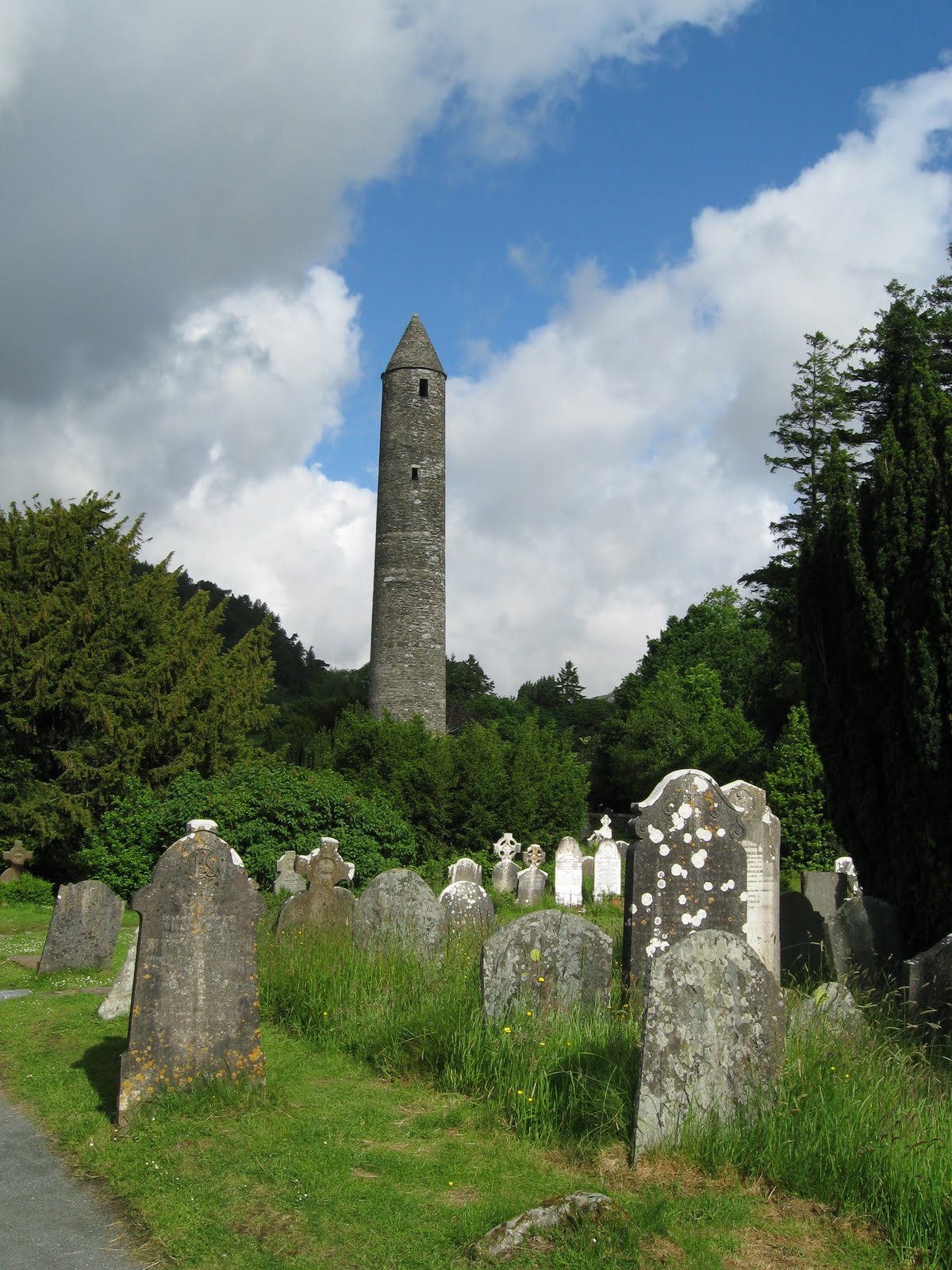
I look back to my first blog post written in London (in transit to Jerusalem) and notice its focus on a local cemetery-turned-public-park. Funny: this evening I walked throu
gh another cemetery, part of Glendalough National Monument in Ireland. Centuries ago, St. Kevin found a stunning, serene mountain valley embracing two narrow lakes and decided to live in a hard-to-reach cave as a hermit. As news of his commitment and wisdom spread, followers arrived. Since it became difficult to be a popular hermit, he founded a monastery instead.
On my way back from the local tavern with correct change for the internet service, I realized that I could have the old monastery grounds to myself away from the daily tour bus crowds. The double stone arch marked my entrance as I made my way past a roofless stone church, its floor now covered only with gravel and the occasional grave marker. A vista opened down the valley we had hiked earlier today, swallows flitted past, and it suddenly occurred to me that this was sacred ground. I slipped off my sandals, not because a burning bush began talking to me, but as a way of honoring this place of rest and devotion to God. Even more, I thought as I walked on the fine gravel, I wanted to honor and give thanks for the privilege of time and money that made this trip, peppered with pilgrimages, possible. We return home to the busy business of moving to Tennessee and beginning three years of seminary study. I will bring with me a quieted inside, gratitude, a renewed awe for God's expansive creation and a honed respect for history and what it tells us today about what humans are capable of.
I look back to my first blog post written in London (in transit to Jerusalem) and notice its focus on a local cemetery-turned-public-park. Funny: this evening I walked throu
gh another cemetery, part of Glendalough National Monument in Ireland. Centuries ago, St. Kevin found a stunning, serene mountain valley embracing two narrow lakes and decided to live in a hard-to-reach cave as a hermit. As news of his commitment and wisdom spread, followers arrived. Since it became difficult to be a popular hermit, he founded a monastery instead.On my way back from the local tavern with correct change for the internet service, I realized that I could have the old monastery grounds to myself away from the daily tour bus crowds. The double stone arch marked my entrance as I made my way past a roofless stone church, its floor now covered only with gravel and the occasional grave marker. A vista opened down the valley we had hiked earlier today, swallows flitted past, and it suddenly occurred to me that this was sacred ground. I slipped off my sandals, not because a burning bush began talking to me, but as a way of honoring this place of rest and devotion to God. Even more, I thought as I walked on the fine gravel, I wanted to honor and give thanks for the privilege of time and money that made this trip, peppered with pilgrimages, possible. We return home to the busy business of moving to Tennessee and beginning three years of seminary study. I will bring with me a quieted inside, gratitude, a renewed awe for God's expansive creation and a honed respect for history and what it tells us today about what humans are capable of.
Tuesday, July 13, 2010
Why I Just Walked 72 Miles
As you can imagine, we had a lot of time for thinking, so I spent some of the time pondering the question, "Why am I doing this?!" The coolness factor, for starters: when else will I walk 69 miles in 4 days and 21 miles in one day ever again? Good bragging material, clearly. As a goal-oriented Western experience collector, there was a specific goal and (thankfully) good signage that led to a successful arrival at our destination.
Then there's the pragmatic rationalization: since I'm soon to
begin seminary and aspire to become an Episcopal priest, I figured it would be helpful as I imagined how far Jesus walked from the Sea of Galilee to the Jordan River by Jericho to be baptized. Practical, right?We figured it would be fun to travel with Matt and Molly, and it was. The four of us hadn't really factored in how the my-foot-is-about-to-explode pain might detract from the fun quotient, however.
Of course, there was something else larger than these reasons and less tangible, more mysterious. For more than 1000 years people have walked far greater distances than our measly 116 km for penance, for hope, in faith. Pilgrims packed Santiago's cathedral at the end of the journey for the daily Mass, sitting at the base of columns, standing everywhere, beyond tired and still searching for something even as we realized this particular quest was over. We yearned for a ritual that would preserve the spirit of this experience and guide us in a new direction.
We head to Ireland for 9 days tomorrow, and then we will be home in San Diego for only a few days before driving to Tennessee to begin seminary. It too will be cool, practical, and fun (hopefully free from foot pain, though) -- but it also involves a larger, longer, and more mysterious search for Home.
Sunday, June 27, 2010
Dawdling in Dalarna
Since Thursday, we've come to know the depth and breadth of Swedish hospitality while staying Laurel's relatives in Mora, a small town in the Dalarna region. The blood line goes impressively far back in time: Laurel's great great grandmother, Brita, had a brother through whom our Swedish relatives descended. Like 150 years ago. And we're being treated as kindly and generously as if we were first cousins. Gunnar, Ingritt, Daniel, Andreas, Anna, and Lynnea graciously welcomed us into their lives even after we passed the 3-days-makes-stinking-visitors mark! It's pretty cool to know that we have Swedish friends, no, Swedish family we can stay in touch with so we don't have to depend on Jon Stewart to keep us updated on the country...The food has been spectacularly tasty. I've at times been tempted to change my three favorite food items (tortillas, Tillamook cheese, and avocados) to rye crisp, white Swedish cheese, and butter.
Butter is an amazing, amazing invention, as is kavelgris, a type of thin bread with a pita-like texture but sweeter and spiced subtly with anise and fennel. I've found out that moose meat is pretty darn good, and that schapps goes well with nubbesallad, a mix of hard boiled egg, pickled herring, dill, lemon peel, and creme fraiche.
Most fortunately, we visited the area, which is known for retaining its traditional heritage, during one of the biggest festivals of the year: midsummer. Every year on the Friday closest to June 25 (I think) the whole country takes the day off, and in Dalarna, most folks jump in traditional dress and walk to the town square for dancing and the
raising of a maypole. Most unfortunately, it started raining during the start of the dancing, so merrymaking didn't last as long as normal. But, we still got to see the maypole-raising process, which would have made any engineer proud. The pole measured more than 50 feet long and took 10 people to carry to its stand. Then, over the next ten minutes, about 30 villagers lifted the pole foot by foot using tree-length support beams. Decorated with pine needle wreaths, the pole stands securely in the middle of village squares all over Sweden until ne
xt year's festival: an ancient and public act of gratitude for summer's warmth and long hours of sunlight.Sweden reminds us a lot of Minnesota but with better health care.
Subscribe to:
Posts (Atom)