Second Sunday after Epiphany
January 18, 2014
1 Samuel 3:1-10(11-20)
Psalm 139:1-5, 12-17
1 Corinthians 6:12-20
John 1:43-51
I’m conducting an informal poll this morning and am wondering if anyone has recently woken up, rubbed their eyes, and looked into the mirror and thought, “Wow, I am marvelously made!” Hmm. Not many. There probably will be more folks at the 10:30 service…
Today’s psalm does push the bounds of hyperbole for our 21st-century ears unused to such flattering compliments about these bodies our minds happen to be lugging around. What do you think about your body? Do you think about your body? I think about my body in chiefly two ways: when will my body be ready to eat next -- because I really love to eat -- and how can my body avoid brain damage by ducking in a timely fashion as I walk through doorways. But what about you? As more of our occupations require less and less physical movement, our bodies can be dismissed and largely ignored as irrelevant to daily life For some, bodies are annoying animals we’re forced to sustain that always seem to be hungry or need to go to the bathroom or receive medical treatment; indeed, bodies can be sources of discomfort, pain, and suffering -- reminders of our limits, of times gone by, of aging and death. Or bodies can be triggers of feelings of guilt, shame, embarrassment; they can be punished and controlled, pressed up and down and in and prodded and enhanced and starved. Alternatively, bodies themselves can be worshipped and sexualized and objectified and thus become temptations for vanity, addiction, self-obsession, and sexual impropriety. Then, of course, there is all that our bodies may be delightfully fit to do: to dance and to dive, to run and to crab crawl, to reach and to give, to fight and to love. Certainly the usefulness and worth of our bodies are interpreted by ourselves and others in a variety of ways.
Science tells us that our bodies are spectacularly complex systems enlivened by chemical interactions we still struggle to comprehend, made up of organs made up of cells made up of protein polymers made up of amino acid molecules made up of atoms made up of protons and neutrons and electrons made up of quarks made up of . . . well, stardust. Hmmm. I’m not sure if that’s a good thing, or . . . ?
But what does God think about our bodies? What does God think of our bodies? God thinks we’re marvelously made. We have been blessed by a marvelous Creator, an artist who knew us before our mothers did, who handcrafted our 37 trillion cells with attention and grace, and who had the humor and audacity to toss in personality quirks and bodily imperfections that would shape us into who we are today. Our bodies are good enough and worthy just the way they have been created, and they are as tightly tied to our identities as our political views and family trees. Our bodies, our stardust, are tied inextricably with God’s loving and skilled and artistic hands. Our bodies not only consist of material, but also of loving relationship.
St. Paul explains in today’s reading: “Or do you not know that your body is a temple of the Holy Spirit within you, which you have from God, and that you are not your own? For you were bought with a price; therefore glorify God in your body.” Our bodies are temples of the Holy Spirit! Our bodies are temples of the Holy Spirit. Our bodies are temples of the Holy Spirit. Our bodies are temples of the Holy Spirit, not just any spirit, not a shared piece of a larger spirit, no -- the Holy Spirit. Are we hearing what St. Paul is telling us?! Our bodies are lovingly crafted gifts to us that speak of God’s love for us, gifts which house God’s wild presence here on earth. The idea of our bodies as temples of the Holy Spirit is deep, deep mystery; wonderfully encouraging; and quite terrifying.
Because what if we’re not sure we’re up for the responsibility of housing the Holy Spirit in our embodied abodes? What if our bodies don’t work the way they’re supposed to, or the way they used to -- can the Holy Spirit still reside within, or would She even want to? (It’s helpful to remember that St. Paul himself had a debilitating bodily infirmity, a “thorn in the flesh,” that caused him great suffering but still could not hinder his enthusiasm for these bodies of ours that aren’t really ours, but God’s.) Our bodies’ purpose, like a temple, is to glorify God. So what does it mean to glorify God in our bodies?
It means employing our vocal cords to sing with joy and energy alongside our magnificent choir; it means holding out our hands to receive Christ’s body sacrificed for us; it means kneeling in humility and thanksgiving; it means showing a sign of peace to a stranger.
It means looking in the mirror and seeing God’s grace and gift; it means allowing ourselves not to be perfect and knowing that the Holy Spirit is with us all the same; it means taking care of our bodies because we’re already loved by God, not so that we’ll be loved by God or anyone else.
Glorifying God in our bodies means picking up the phone to call a lonely neighbor, driving the kids to soccer practice, massaging our partner’s feet at the end of a long day, and taking the dog for a walk while we pray.
Glorifying God in our bodies means participating in an Arts Committee gathering, attending the Cathedral’s annual meeting (get your free lunch at noon today!), bringing communion to a congregant in a nursing home, ironing the linens in the sacristy.
Glorifying God in our bodies means marching our way down the streets of Paris along with a million others to demonstrate that violence cannot rule the day. It means serving alongside dozens of others to clean up Balboa Park this Monday as our nation celebrates Martin Luther King, Jr. (The Cathedral, led by our Simpler Living ministry, will participate in this interfaith day of service, and you’re invited! Check out the bulletin announcements for details.)
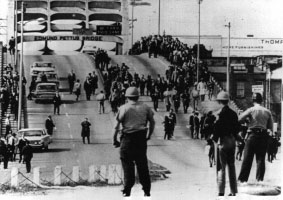
Glorifying God in our bodies means heading south out of Selma, Alabama on Highway 80 on March 7, 1965 with 600 members of the Student Nonviolent Coordinating Committee and Southern Christian Leadership Conference; it means crowning the Edmund Pettus bridge that spans the Alabama River and taking in the mass of mounted state troopers and just-deputized white males waiting for them on the other side with clubs and tear gas; it means a world shocked by the televised images of nonviolent resistance in the face of unthinking brutality; it means hospitalization; it means presenting our bodies as living sacrifices for a cause greater than ourselves, the cause of equality before the law, the cause of human dignity, the cause of justice.
I wonder if those marchers knew what they were getting into before they crowned that bridge that day, before they took in the menacing threat before them? I wonder if we know what we’re getting into when we get out of bed each morning as we profess to follow this peasant teacher, this rabble rouser, on his dusty, meandering march to Jerusalem? I can’t help thinking that we enjoy the same human bodies as those Selma marchers -- there wasn’t anything different about their flesh and blood and bones -- and we profess to follow the same Jesus, the same Christ, whose body was broken by the powers of his day, and whose body was glorified in that rock-hewn tomb. Jesus has invited us to follow him. Follow where? Toward justice. Toward brokenness. Toward glory.
Showing posts with label joy. Show all posts
Monday, January 26, 2015
Wednesday, November 19, 2014
Looking for Answers: A Sewanee Sermon
Good morning! Thank you for inviting me to be with you today. My name is Colin Mathewson, and my wife and I graduated from The School of Theology some 18 months ago. We’ve been priests just 13 months now. We’re serving at St. Paul’s Cathedral in San Diego, where one of my roles is to pastor our small Latino congregation. I appreciate the opportunity to be with you for this Spanish language Eucharist, because I believe deeply in the importance and possibilities of Latino ministry, and I am grateful that The School of Theology continues investing in and growing its Spanish language and Latino ministry program. I know my time at Sewanee did much to inspire and prepare me for this current work of mine. I hope many of you are having a similar experience here, too. Know this -- for those called to serve among Latinos, the harvest is plentiful! Keep working on your Spanish, venture out of your comfort zone, laugh at yourself when you sound silly, but keep at it. The Church needs you. And Latinos, as do all of us, need the Church.
Except when we don’t need the Church -- or we think we don’t. One of the favorite parts of my job is having coffee with folks in their 20s and 30s who declare to me that they are spiritual but not religious. (That phrase makes me smile.) I listen to their stories, which often involve baggage with some form of the institutional -- and often nondenominational -- church. They’re not quite sure why they’re sitting down with a priest in a public place (I think the collar is unnerving to some of them). Yet they yearn for greater purpose and meaning in their lives. They wear quizzical expressions on their faces while holding a thread in their hands and trailing behind them a pile of unraveled fabric — the fabric of a culture that promised their bodies alluring and comforting answers to life’s biggest questions but left their souls cold. I loved these conversations as a lay person before seminary, and I love them even more now -- seminary pointed me to a rich wardrobe of Scripture and tradition to share. Indeed, there is much good news to tell, and so I wonder where to begin. Evangelism can be dicey with millennials -- their B.S. monitors are sensitive -- pat answers make them suspicious.
The stories of the saints are often a good place to start. Take Elizabeth, princess of Hungary, whom we celebrate today. A member of the royalty, she married at the age of 14, was widowed at 20, and at age 24 died an entirely preventable premature death. She died from an illness contracted from those for whom she cared for in a hospital she didn’t have to build and certainly didn’t have to enter into day after day. I wonder what could have possibly turned blessed Elizabeth’s gaze slowly, slowly around until all she could see was the poor, and Christ among them? She had plenty to live for: three kids, an income from her family, many chances to remarry. But she chose to give her life away for a very real purpose instead. She gave her life to God. “Why would someone do that?,” I ask my coffee shop companion. Why would someone do that?, I ask you. Why would someone do that?, I ask myself.
One coffee shop companion of mine, a woman in her 30s named Selina, recently renewed her participation in our Latino congregation’s communal life. She is the single mother of elementary school-aged daughters, and she struggles to find a job while she and her family live on welfare. On a Saturday night a few months ago, Selina received a call that her father in Mexico City had died suddenly from a heart attack. Undone and unsure what to do, she came with her daughters to church the next day. As she wept before and during worship, members of our family-sized congregation comforted her and cried beside her, for Selina’s grief had reminded them of their beloved family members and friends living on the other side of a border that many were not authorized to recross again.
During coffee hour, prompted by a leader in the congregation, I invited those present to offer what they could to help cover the costs of the almost $700 plane ticket that would allow Selina to bury her father. I issued this invitation obediently, but not hopefully: this Latino congregation was comprised of the working poor: carpenters, carpet layers, truck drivers, house cleaners, landscapers, nannies.
But, thanks be to God, I’m here to tell you that my parishioners gave twenty, forty, fifty dollars each -- and among a couple dozen folks we’d raised enough to fly Selina home. The church’s pastoral needs fund covered the rest.
Why did my parishioners, these saints of the Church, do that? Some sense of purpose most certainly lay behind it. Was it their own devotion to family that compelled them to give so sacrificially? Was it their devotion to a God of love and abundance that prompted them to take the risk of sharing the few loaves and fishes they had with one another? There was a hidden richness from which they drew on this extraordinary collective wealth.
I expect our parishioners’ generosity did affect those family members who depended on them in the days to follow. But as I reflect on this miracle I can’t help but think that their giving preserved and strengthened their devotion to family and to God more than if they had kept their wallets in their pockets. The invitation to give, issued not by their priest but by the tears of a suffering fellow church member and friend, transformed any sense of scarcity they might have felt in that moment into a sense of abundance. From this present abundance they gave to meet a real need, and it was the Church, it was Christ, that bound together and made possible this moment.
I share this not to romanticize poverty or to overgeneralize the generosity (or poverty!) of a particular cultural group. I share this because I watched Christ sweep away fear and the Spirit usher in Love before my eyes. I witnessed a grieving daughter who needed the Church and saw the Church come through for her.
A month after her trip, I invited Selina to serve as the Latino congregation’s representative for the Cathedral’s newly minted Evangelism Committee, organized to proclaim joyfully the good news of Christ in our community’s life. Committee members plan to do this at street fairs, in parks, and yes, even in coffee shops. I’m certain this single mother of two struggling to find a job is the right person for this ministry, for she has tasted and seen this good news in the spontaneous offering of monetized love from her friends at church. She can point to it. It is fresh in her gaze. She had crossed path with saints who had themselves discovered a deeper purpose and joy in Christ.
Look, most of us are not called to almsgiving heroics. Most of us have real financial constraints in our lives, real responsibilities to our families and our dependents (older and younger). And few of us have access to the precious gems and royal granaries that Elizabeth had at her disposal to care for the needy. That said, each of us is included in Christ’s call to submit ourselves and our lives fully at the feet of our Lord and Savior — not merely represented by giving ten percent of our income, or twenty percent of our talent, or thirty percent of our time to the church, or any other calculation that constricts our response to Christ’s invitation to present ourselves in our entirety to God, one hundred percent. (Thank you, Mother Julia, for helping me to see this.)
Giving all of ourselves to God: this is a challenge, this is a purpose, that is at once intimidating and liberating — and compelling. Sure, it’s easiest to feel how giving ourselves entirely to God is intimidating, for who in this life can boast such a feat? Our confessions remind us of the ways we withhold our love from God and others.
Yet it is liberating because this call to giving 100% of ourselves means that our financial resources are but one offering God invites us to place on the altar. Providing for our families in such eminently practical ways as buying school supplies for our kids or helping with cost of elder care for our parents take on a sacredness revealed in all we do that affirms life and life’s intimate relationship to our Creator.
And truly, this call to give our all is compelling. It is compelling because we humans from an early age have suspected that there is more to living than what our mainstream culture entices us to buy and sell. There is more to who we are than our net worth, our assets, the number of our Facebook friends, our image. Indeed, it is Christ who offers us our deepest purpose, answering our dearest held questions: Who am I? Toward what end shall I labor? What will my time alive be like? Christ calls to each of us, inviting us to turn our gaze toward the poor, toward the lonely, toward the sick, toward God -- so that we might fashion answers to the existential questions that hound us. And Christ gives us the means to do so: the strength, the courage, the joy.
Why did my parishioners do what they did? Why did blessed Elizabeth do what she did?
Unsurprisingly, Christ continues to attract the younger generations — that coffee shop-going crowd. As I sip my tea I reveal to them, and in so doing remind myself, of a precious gift within our church tradition: the saints, who have grappled with great questions of purpose and found Christ in that struggle, and he became their all, and they gave their all to Him. My conversation partner looks away, holding her latte in her hands, silent. I wonder if she is thinking what I am: Could I do the same some day too?
Saturday, October 4, 2014
A Wedding Sermon for Peter and Fei
Peter and Fei, thank you for inviting us here today to witness and bless your marriage. Too rarely
these days do we have the chance to celebrate love, to celebrate its power to transform we tiny humans into something greater and more real. But look! Look at what you’ve done to each other! Look at what love has done to you. We, your family and friends, have witnessed the good that your love has brought both of you, and we affirm it and bless you this day.
It’s easy on the surface to celebrate love between two people. But real life love goes deeper than that, or it must if it is to weather the challenges and stresses of any marriage. I tell you this because I care so much about what you are to embark upon, as we all do, as we all commit to support the two of you however we can. And so I submit to you a precious truth that our poet, Kahlil Gibran, revealed: it is the truth that this good, good love that you share is not your love, not really. It is contained by an even greater Love, an even greater Life, it is contained by God -- and it springs forth in your lives because you are loved by this greater Love. You are loved by God. We are all loved by God. All of us. Always.
But what does God’s love have to do with your marriage? This truth about God’s love matters most precisely when you feel like you’ve got this marriage thing figured out all by yourselves. Because marriage can be a squirrelly thing, full of surprises and joys and its share of sadness. Ah, but you’ll never need to go it alone. You’ve got us here, and more importantly, you’ve got a greater Love beside you that never fails. Trust it, lean into it, and it will carry you places unexpected and filling and new.
Peter, I’ve known you for 21 years. Fei, it’s crystal clear you are just what Peter needs, thanks be to God. And Peter, never forget that Fei needs you, too.
And so we today celebrate this love you share, this glorious Love, this always Love, together by your side.
Tuesday, June 5, 2012
Given to Water
the pebbled beach stretches before us
yawns, still waking up
insistent waves rake against rock
baptizing shore incessantly
with Robin in my arms I jog imbalanced
a 25-pound toddler clinging to my left while
the ground slopes seriously to the right
given to water
so is she: wiggling loose from grip, I let her down
and watch her waddle-sprint across the wind-whipped beach
last spent waves greet little shoes
bell-like laughs ring from her belly
I scoop her up and stride farther still
until, passing a dilapidated dock
we spook a heron into flight:
startled, speechless, we witness
primal escape to safety
now loping more easily, the sand sturdier here
I turn in circles as I run with Robin
“moh,” “moh” she cries and signs
we dance, we two, to a song of creation
divinely designed in Eden to harmonize
the two of us to each other, to all people
the kingdom of heaven a concert of
insistent waves and herons wings
belly laughs and serious sand
given to water
Sunday, April 29, 2012
Sunday Prayer: Knowledge
O God, all-wise in love and keeper of knowledge, who invites us through Jesus Christ to be fools so that we may be saved; grant that students everywhere may persevere in their task with clearness of head and stoutness of spirit, so that all power and glory enabled in human understanding may be finally poured out onto you; through Christ our Lord. Amen.
Saturday, April 28, 2012
Softball and cookout
Softball playing with sixty percent kids, the rest semi-out of shape adults, on a chalked field with bases: then grilling in the park with my parents and fellow seminarians, perfect weather: this is the shape and taste of an Easter blessing.
Thursday, April 26, 2012
Parents
There's not much more joyful than a visit from my parents. I'm feeling as full of love as I am of carne asada burrito(s)!
Monday, April 23, 2012
Sunday, April 22, 2012
Sunday Prayer and Poem: Tread and Wait
O very real God, who knows our pain as fellow sufferer and sojourner along life's way, grant that we may comprehend the fullness of your risen life so that our hope may be sustained in the face of the brokenness that surrounds us; through Christ our Lord, who makes all things whole and all matters new. Amen.
Tread, and Wait
Our Father plows furrows
ever deeper into our hearts, so that He who is in heaven
may be glorified by weary feet
trudging alongside that coming kingdom, bearing a
portion of its willed freight
the footsteps joined in happy pilgrimage wear down
this godly trail till the earth brings forth
its luminous fruit.
And so we tread on holy ground, and wait.
Tread, and Wait
Our Father plows furrows
ever deeper into our hearts, so that He who is in heaven
may be glorified by weary feet
trudging alongside that coming kingdom, bearing a
portion of its willed freight
the footsteps joined in happy pilgrimage wear down
this godly trail till the earth brings forth
its luminous fruit.
And so we tread on holy ground, and wait.
Saturday, April 21, 2012
Fog
Fog transforms our home into a lonely ship on a still, dark sea. Looking out a porthole I glimpse waves of trees sprayed with leaves. Once in a while a headlighted whale glides by. Ships beside ours remain unmoved, above water, catching their breath. Grey, mysterious peace.
Thursday, April 19, 2012
Easter Light
A classmate's sermon tonight invited us to reinterpret the past in light of Easter using a lens of joy. That's exactly what I've been trying to do but had been working with the present instead of the past. Does Easter light redeem all it touches? Perhaps not, but even when it doesn't, it illumines something new worthy of fresh consideration.
Monday, April 16, 2012
Sea Trees
Waves crashing into coved tide pools
stir confused water back upon itself, sideways
all around
leaves follow this wild watery course when
wind blows their slender trees in every direction
cauldrons of chlorophyll
could anything be as complicated
or as simple?
Sunday, April 15, 2012
Sunday prayer: Springtime
O God of leafing trees and playgrounds, O Lord of the hopefulness of windy spring; Grant that we who are made new through your Son's Body the church may show forth your joy to the world with the energy and conviction of breezes, laughing kids, and sunshine; through Christ our resurrected Savior. Amen.
Saturday, April 14, 2012
Pasture Walk
An after dinner stroller walk with Laurel, a friend, and two toddlers led us to a quiet sloping pasture with three horses. We learned that holding out our hands in a feeding gesture can be quite attractive to horses, so they lolled over. A breeze picked up, the sunset waited patiently for the kids to pet their furry friends, and we laughed a lot on the way home.
Thursday, April 12, 2012
Allegri Miserere
Our systematic theology professor played Allegri Miserere for us today, and it is surely one of the most beautiful pieces of music I've ever heard. It was composed in the 1630s for the pope, who only allowed it to be sung in the Sistine Chapel for a hundred years until the composition was finally leaked to the rest of Europe. Its words are those of Psalm 51. Listen!
Wednesday, April 11, 2012
Bread
This evening I finally figured out how to make whole wheat naan that won't set off the smoke alarm: bake it! There are few things more satisfying and joy-filled than making, then eating bread with friends.
The prayer for today, which is Wednesday in Easter Week, is: "O God, whose blessed Son made himself known to his disciples in the breaking of bread: Open the eyes of our faith, that we may behold him in all his redeeming work; who lives and reigns with you, in the unity of the Holy Spirit, one God, now and for ever. Amen."
Back in the pew after communion during today's service, I felt deliciously full.
The prayer for today, which is Wednesday in Easter Week, is: "O God, whose blessed Son made himself known to his disciples in the breaking of bread: Open the eyes of our faith, that we may behold him in all his redeeming work; who lives and reigns with you, in the unity of the Holy Spirit, one God, now and for ever. Amen."
Back in the pew after communion during today's service, I felt deliciously full.
Tuesday, April 10, 2012
Bark
It's morning and I'm staring up into almost leafed-out birch trees towering above my patio. I'm supposed to be praying and I sort of am, since God's all over this beautiful umbrella forest. The light is a fair gold, fresh and ready to burn deeper orange soon. Joy girds like bark.
Monday, April 9, 2012
Finished a Paper!
Joy came quickly when invited to celebrate my finishing of a 21-page paper on the "theological ethics" of Stanley Hauerwas. Thanks be to God!
Sunday, April 8, 2012
Joy's Risen
Easter feels like this. During Easter season, I'll try to find a slice of joy in each day's pie to serve briefly here!
On Sundays I'd also like to write a prayer:
O Risen One, Lord of the line separating life and death: May the power of your holy victory spread to the ends of the earth, so that all people may know the gift that is your love; through your mighty and mysterious majesty, O God, now and forever. Amen.
On Sundays I'd also like to write a prayer:
O Risen One, Lord of the line separating life and death: May the power of your holy victory spread to the ends of the earth, so that all people may know the gift that is your love; through your mighty and mysterious majesty, O God, now and forever. Amen.
Subscribe to:
Posts (Atom)


